
If you’re planning to install a new furnace in your home, you'll need to start by choosing which furnace type is best for your situation. Your home’s configuration and your annual heat usage are two key factors in this decision-making process. Keep reading to see how you can stay warm all winter long.
Airflow Furnace Basics
The main difference between a downflow furnace and an upflow furnace is the direction of airflow input and output. Here’s a breakdown of how each furnace type works:
Downflow Furnace
Air enters the furnace from the top.
The air is heated in the heat exchanger.
The heated air travels through the bottom of the furnace and into your ductwork where it circulates throughout your home.
Upflow Furnace
Air enters the furnace from the bottom.
The air heats up in the heat exchanger.
The heated air exits the furnace from the top and circulates through your ductwork.
[caption id="attachment_4405" align="alignnone" width="956"]
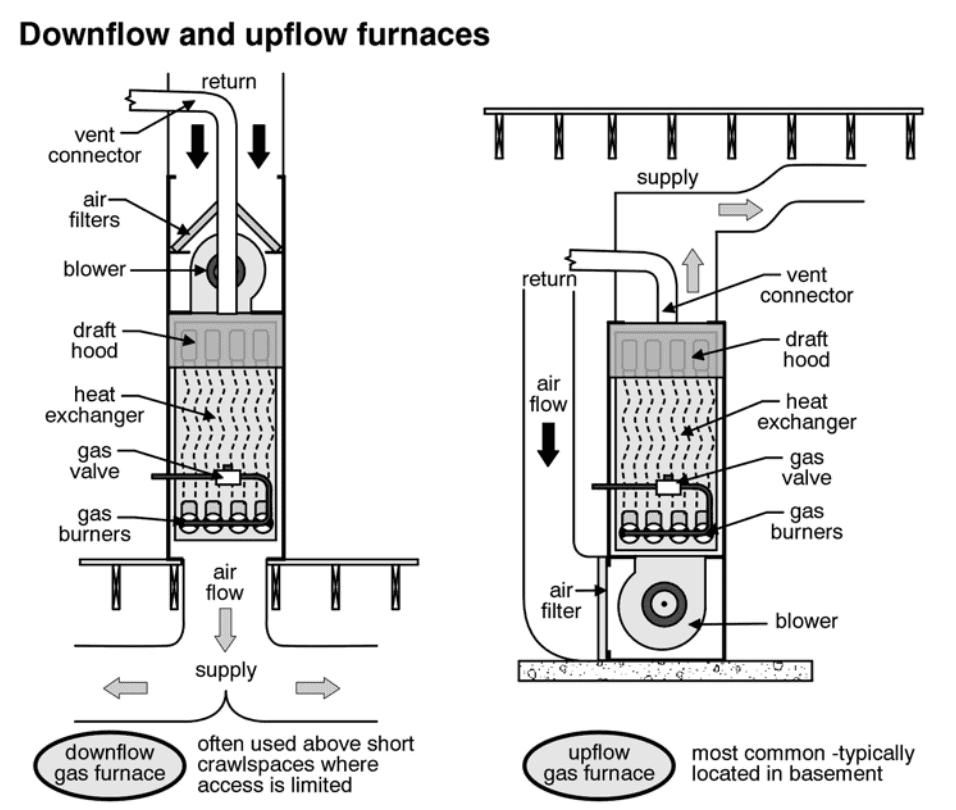
Image Credit: www.npiweb.com\[/caption\]
Downflow Furnaces: A More Efficient Choice for the Attic
Downflow furnaces are installed in attics because the warm air produced travels downward. Since heat naturally rises, the configurations of a downflow furnace force it to do more work as it pushes air downward. By going against the grain, downflow furnaces use more energy and undergo more wear and tear during operation. Downflow furnaces are ideal for homes in warmer climates because they require less frequent furnace use.
Upflow Furnaces: Ideal for the Basement
Upflow furnaces are installed in basements and crawl spaces because the warm air produced travels upward. Since heat naturally rises, the configurations of an upflow furnace enable it to do less work. This means the unit uses less energy and experiences less wear and tear. Upflow furnaces are better for homes in colder climates since they require more frequent furnace use.
Downflow vs Upflow Furnace Pros & Cons
Below are the main advantages and disadvantages you should consider before choosing between a downflow furnace vs an upflow furnace.
Downflow Furnace
Pros
Can be installed in any type of home
Cons
Less energy-efficient
Less cost-effective to operate
Reduces furnace lifespan due to increased wear and tear
Not effective for basements or crawl spaces
Difficult to install
Upflow Furnace
Pros
More energy-efficient
More cost-effective to operate
Maximum furnace lifespan due to minimal wear and tear
Simple installation
Offers optimal home comfort throughout the winter
Con
Not effective for attic use
If you’re not keen on installing an upflow or a downflow furnace, one alternative to consider is a horizontal flow furnace. Rather than the air entering and exiting through the top and bottom of the unit, it enters through one side and exits through the other. Horizontal flow furnaces offer a more flexible installation process, as they don’t have to be installed vertically.
Call Eanes Heating & Air Conditioning for a Furnace Installation
Whether you need a new furnace to replace your current unit or for a home build, Eanes can help you determine which furnace type is right for your home. Once you choose a furnace type, schedule a convenient next-day installation with our team to maximize your home comfort. You can count on us to perform an expert installation that will last for years to come.
Related Articles
What do you need help with today?
Heating
No heat, strange smells, rising bills? We repair and replace heating systems to keep your home reliably warm.
Air Conditioning
AC blowing warm air? Uneven cooling in your rooms? We fix cooling issues fast and keep your system running smoothly all summer.
Plumbing
Our highly trained plumbers handle it all, from leaky faucets to full system installations and repipes.
Electrical
The smartest team in town. You need repair, installations, wiring, inspections, lighting — you name it.